Infrastructure Architect
Part 4 Chapter 6
Rise of The Private Cloud Architect

This is a story of the life of a VMware Admin that I shared as an impromptu presentation at our VMUG Singapore back in 2014 and it still resonates until today.
The restaurant business provides a good analogy to your IaaS business. You, the private cloud architect, are the Chef. In that end-user environment where you work, you are the expert in producing what your customers want. You architect and design a solid platform, where your customers can confidently run their VMs. If there is an issue, you often get involved, restoring their confidence in your creation. You are seen as the VMware expert, or the virtualization expert. Yes, you may engage VMware Professional Services or Support, but they are not employees of you company. You are the employee. As far as your customers concern, the buck stops at you.
You do not sell hardware nor software; you charge your customers per VM. In fact, to ensure that your customers order the right kind of VM, you need to charge per vCPU, per vRAM and per vDisk. The chargeback model is something that I very rarely see discussed. We tend to stay in technical discussions. We need to realise we are no longer just a System Builder. We are Service Provider. By not extending our circle of influence into how Application Teams should pay for our service, we created the issue we have today (Oversized VMs, dormant VMs, VM sprawl). We need to “step out from the kitchen” from time to time. We need to be like the Chef who steps out into the dining area, building relationships with his customers, explaining the reason behind his cooking.
As the Architect, we are the best person to determine how much to charge for these. We built this environment. We know the costs, and we know the capacity. Not convinced? Put it this way, would you rather someone else determine how much your creation is worth?
We all know that IT exists because of Business. It starts with the Business. Some of the issues we have are caused by unsuitable chargeback models and incorrect Service Tiering. The VM in Tier 1 (mission critical) platform cannot cost the same as the VM in Tier 3 (non-production). I’d make sure there is distinct difference in quality between Tier 1, Tier 2 and Tier 3, so it’s easy for business to choose.
Need a good example? Using the restaurant analogy, say you cook fried rice. It’s your dish. You need to determine the price of the fried rice. You also need to be able to justify why you have normal fried rice and special fried rice, and why the special one costs a lot more for the same amount of food.
To me, the Chargeback model and the Service Tiering serve as Key Drivers to our Architecture. I will not consider my architecture complete unless I include these 2 in my design. We are architecting to meet the business requirements, which are “defined” in the chargeback model (e.g. the business wants a $100 VM per month, not a $100K VM per month), and service tiering (e.g. the business wants 99.999% and 3% CPU Ready).
As shared, I see a chance for us to step up and step out.
-
Step out of the kitchen and network with your customers (the Application team). Educate and fix the problem at the source.
-
Step up from pure IT architecture to business architecture. Architect your pricing strategy and service tiering.
The good thing about pricing is…. your benchmark is already set.
Azure, AWS, Google, and many Service Providers have already set the benchmark. Your private cloud cannot be too far from it. Too low and you will likely make a loss (it’s almost impossible to beat their efficiency). Too high and you will get a complain. Another source of benchmark is to consider what it would cost to run the same applications on physical servers.
Is that all the opportunity for you?
No, you can collaborate with the Enterprise Architecture (EA) team, contributing your domain expertise. EA and Business Transformation Architect tend to look at the big picture. They are more business-centric and more strategic in their perspective.
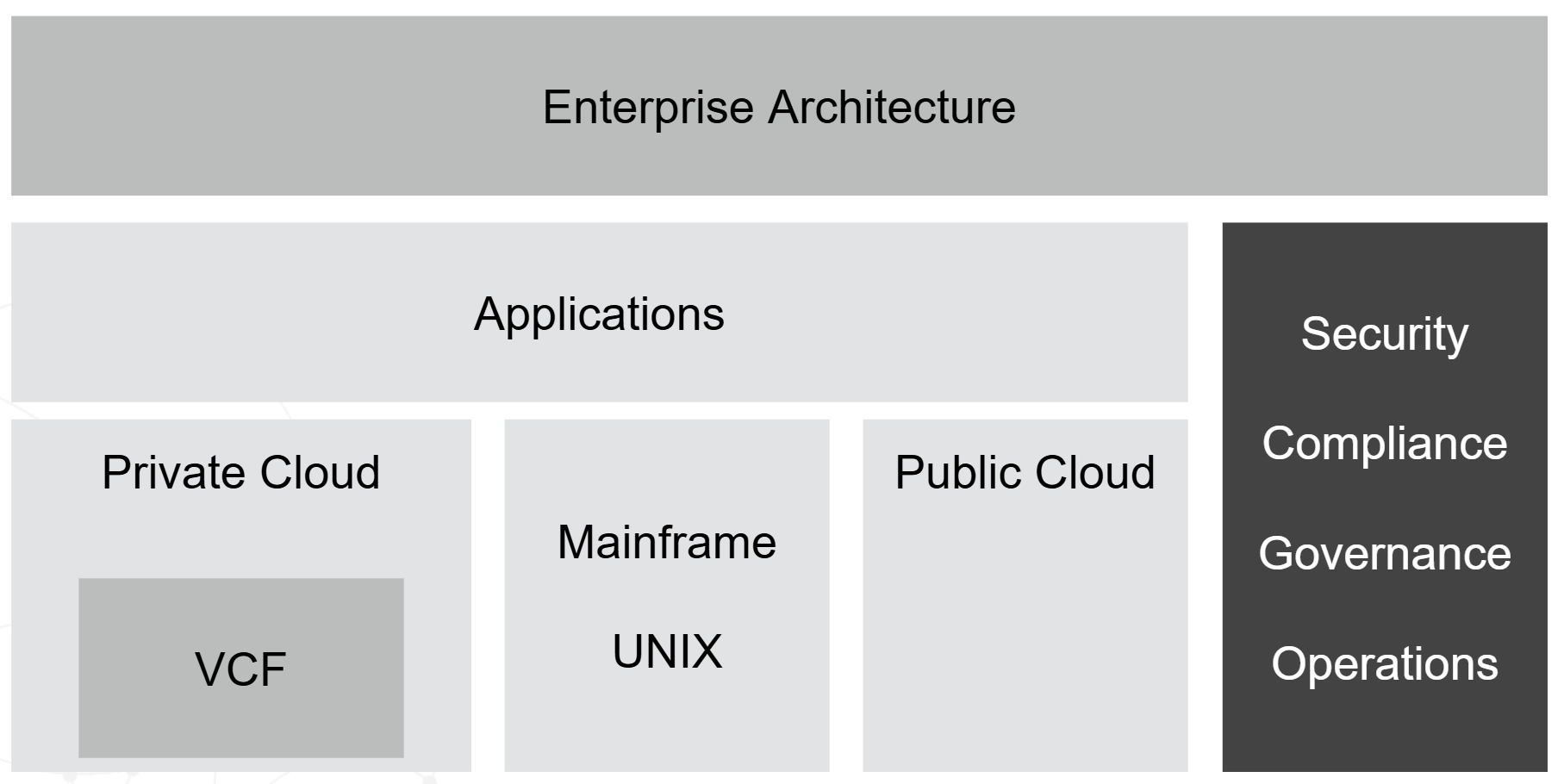
There are also departments such as security and operations. Reach out to them and collaborate.
I hope you enjoyed this perspective of your role.
Do share your life story with fellow vCommunity in various VMUG events.
History of The Books
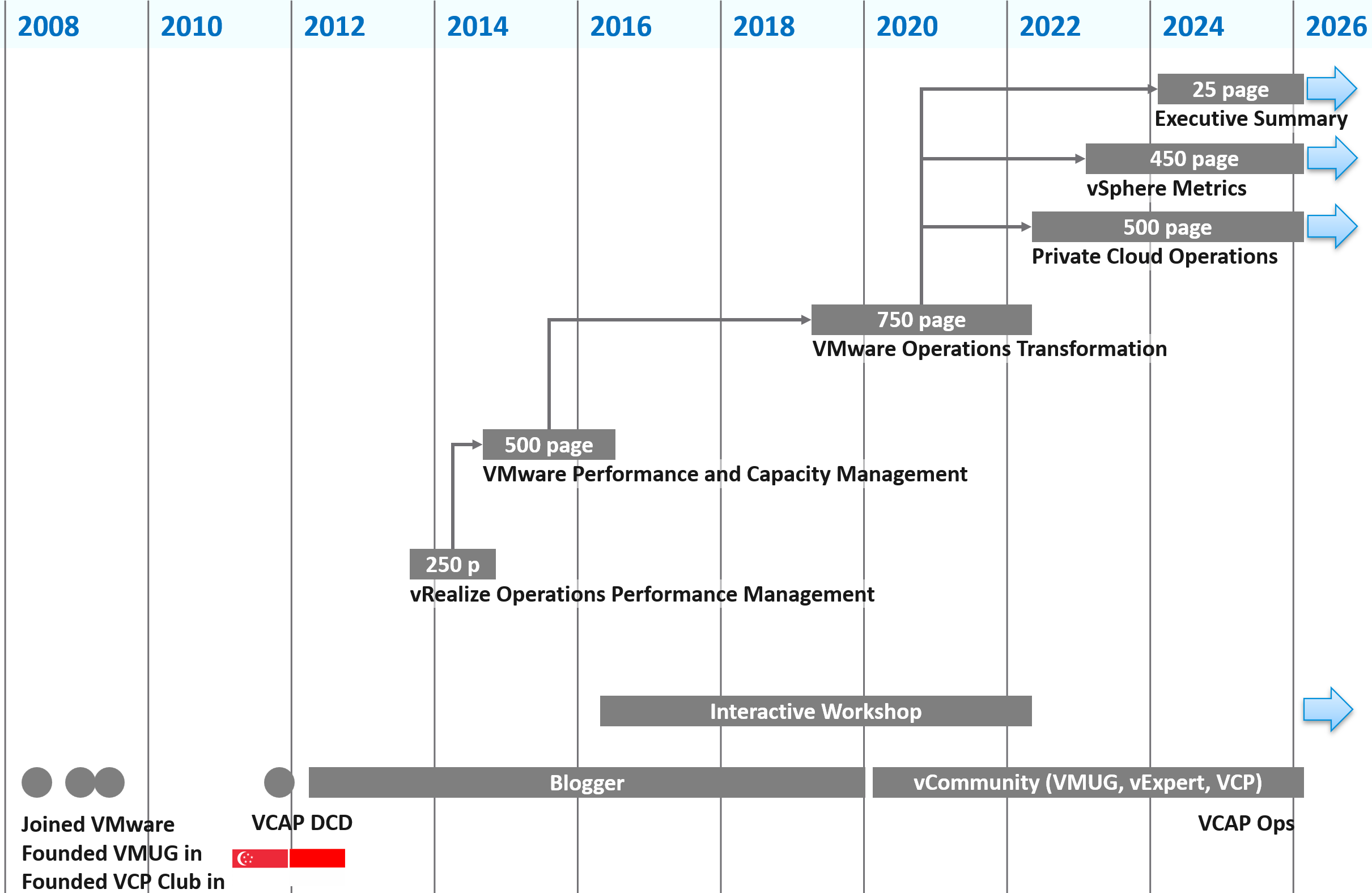
The book you’re reading has its origin on May 2008, when I joined VMware as the first Account SE for global accounts for Asia. Since all my customers had only started ESX adoption, I founded the user group in Singapore. In 2009 I founded the user group in Indonesia. As the community grew, I founded VCP Club so we could do deeper discussion.
In 2011, I was one of the first to pass the VCAP DCD exam globally as beta exam participants. In 2012 I began blogging. That knowledge from VCAP and articles from my blog set the foundation for my first book, which got published in 2014. It was ~250 pages. A good chunk of material was deferred to the second edition, hence the 2nd edition followed within 2 years. At ~500 pages, the scope was broadened and becomes less product-centric, a strategy that becomes clearer over the years.
I took a long break as the effort from writing 2 books as the 3 years of total duration were taxing, and I wanted to leapfrog the next edition. I continued blogging to gain deeper and broader knowledge. I still do a lot of researching and validating even until today, which is why the content evolves every year.
In 2019, I decided to revamp the book. It focused on overall operations management, while deepening on metrics. The 3rd edition was written in the open, meaning an update was released every month or so. After 2 years of writing, the book was finalized at ~750 pages.
In 2022, the chapters on vSphere Metrics became matured enough to be released as a separate book. My hope is we can evolve it to become VCF Metrics in the future.
The continuous release strategy worked well, and the book eventually resulted in 3 books. The goal change from operations management to operations transformation. With Broadcom’s focus on private cloud, the book changed accordingly.